Shopping Cart

Your cart is empty
Continue Shopping

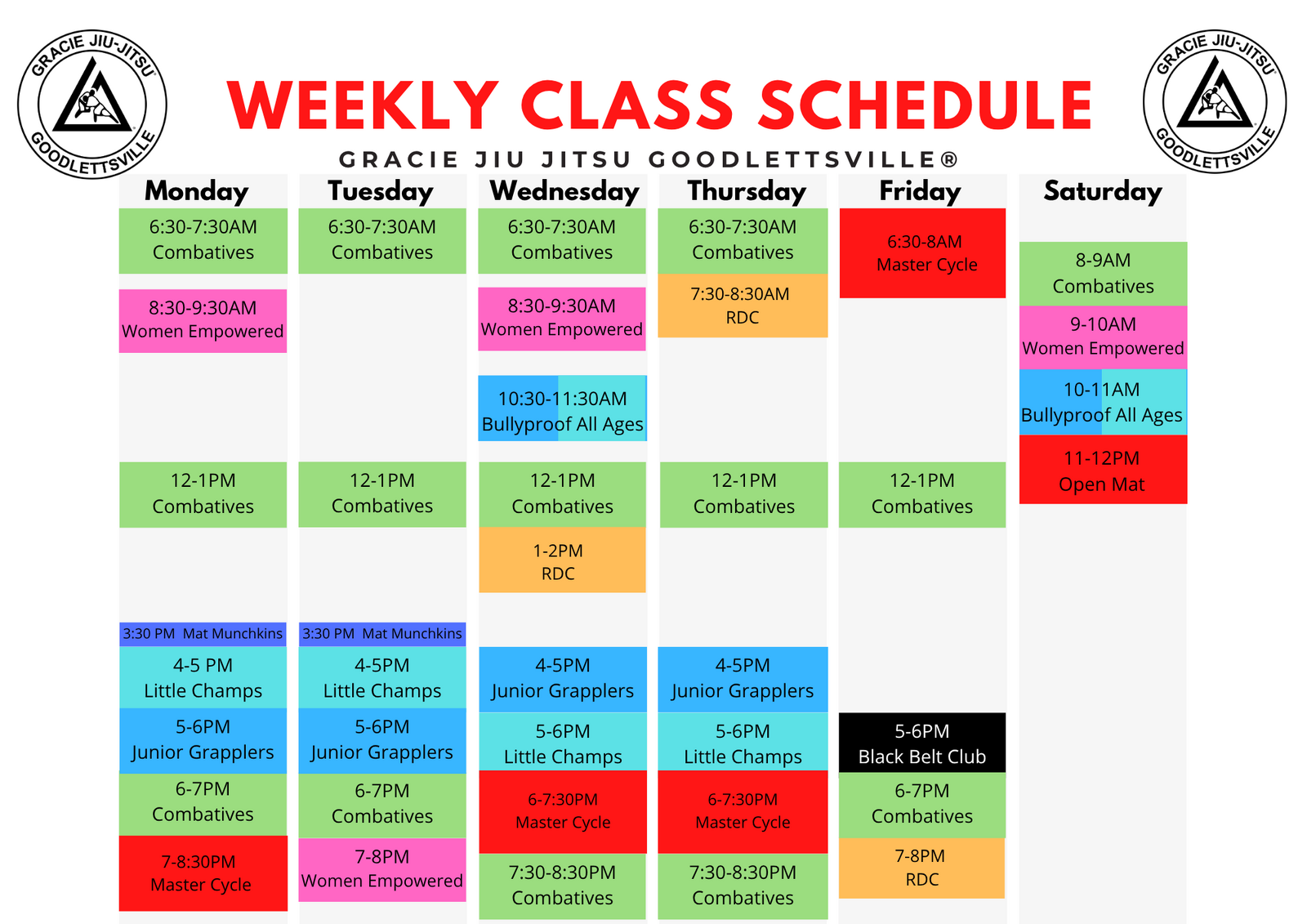
Schedule

11/30/2025 - 12/06/2025
30 Sun 1 Mon 2 Tue 3 Wed 4 Thu 5 Fri 6 Sat
30 Sun
1 Mon
2 Tue
3 Wed
4 Thu
5 Fri
6 Sat
12:00am
1:00am
2:00am
3:00am
4:00am
5:00am
6:00am
7:00am
8:00am
9:00am
10:00am
11:00am
12:00pm
1:00pm
2:00pm
3:00pm
4:00pm
5:00pm
6:00pm
7:00pm
8:00pm
9:00pm
10:00pm
11:00pm

Women Empowered

8 - 9am
8:00am - 9:00am

Women Empowered

KMKelli Martin
Class 05 - Super Slap | Guard Get-ups (5 & 6)

Class 05 - Super Slap | Guard Get-ups (5 & 6)

Striking a larger, stronger assailant in the face with punches has limited effectiveness and may cause you to break your hand. In this lesson, we teach you how to use a Super Slap to disrupt the attack and facilitate your escape. First we will teach you how to maximize power with a solo preparation drill, and then we’ll discuss how to apply the Super Slap in combination with previously learned techniques. In this lesson, we teach you additional variations of this critically important technique to ensure your survival against an attacker trying to punch, pin, or choke you.

Super Slap:
View on GracieUniversity.com

Guard Get-Ups (Choke/Wrist Pin):
View on GracieUniversity.com

Women Empowered
Monday, December 01 · 8:00am - 9:00am
Instructors:
Kelli Martin
Skills: Class 05 - Super Slap | Guard Get-ups (5 & 6)

Class 05 - Super Slap | Guard Get-ups (5 & 6)

Striking a larger, stronger assailant in the face with punches has limited effectiveness and may cause you to break your hand. In this lesson, we teach you how to use a Super Slap to disrupt the attack and facilitate your escape. First we will teach you how to maximize power with a solo preparation drill, and then we’ll discuss how to apply the Super Slap in combination with previously learned techniques. In this lesson, we teach you additional variations of this critically important technique to ensure your survival against an attacker trying to punch, pin, or choke you.

Super Slap:
View on GracieUniversity.com

Guard Get-Ups (Choke/Wrist Pin):
View on GracieUniversity.com

Combatives

12 - 1pm
12:00pm - 1:00pm

Combatives

DJDavid Jackson
Class 18 - Punch Block Series (5) – Guard | Haymaker Punch Defense

Class 18 - Punch Block Series (5) – Guard | Haymaker Punch Defense


Punch Block Series (Stage 5) - Guard
From Stage 4 it is important that you drop your opponent back to Stage 1 as quickly as possible so that you are safest from punches and have the best control over their body. If, while in Stage 4, your opponent is not leaning forward heavily enough to be dropped to Stage 1, it is best to kick them away to Stage 5. In this lesson you will learn how to defend from Stage 5 as well as what to do if the opponent tries to throw your legs aside in their quest for a knockout punch.
Click here to view lesson on gracieuniversity.com

Haymaker Punch Defense
In many cases, the precise movement and aim of your opponent’s strikes are hard to predict. Sometimes, however, your opponent is so eager to attack you that their punch is totally predictable. The Haymaker Punch Defense is used when a determined attacker comes at you from a distance with the objective of putting all of their bodyweight behind one fight-ending punch. Because of this punch’s power and predictability, the best option is to slip underneath it and get behind your opponent.
Click here to view lesson on gracieuniversity.com

Combatives
Monday, December 01 · 12:00pm - 1:00pm
Instructors:
David Jackson
Skills: Class 18 - Punch Block Series (5) – Guard | Haymaker Punch Defense

Class 18 - Punch Block Series (5) – Guard | Haymaker Punch Defense


Punch Block Series (Stage 5) - Guard
From Stage 4 it is important that you drop your opponent back to Stage 1 as quickly as possible so that you are safest from punches and have the best control over their body. If, while in Stage 4, your opponent is not leaning forward heavily enough to be dropped to Stage 1, it is best to kick them away to Stage 5. In this lesson you will learn how to defend from Stage 5 as well as what to do if the opponent tries to throw your legs aside in their quest for a knockout punch.
Click here to view lesson on gracieuniversity.com

Haymaker Punch Defense
In many cases, the precise movement and aim of your opponent’s strikes are hard to predict. Sometimes, however, your opponent is so eager to attack you that their punch is totally predictable. The Haymaker Punch Defense is used when a determined attacker comes at you from a distance with the objective of putting all of their bodyweight behind one fight-ending punch. Because of this punch’s power and predictability, the best option is to slip underneath it and get behind your opponent.
Click here to view lesson on gracieuniversity.com

Mat Munchkins

4 - 4:30pm
4:00pm - 4:30pm

Mat Munchkins

DJDavid Jackson
Chapter 8: Submissions

Chapter 8: Submissions

This week will focus on all the possible submission techniques in jiu jitsu that makes sense for kids in
each age group. Default to “catch-and-release” in Little Champs with no pressure, and allow for light
pressure application in Jr. Grapplers. Incorporating the Rules of Engagement into the instruction and
really emphasizing the safety considerations of each submission, including the importance of tapping out,
will help prepare them for the eventual transition into Black Belt Club.

Mat Munchkins
Monday, December 01 · 4:00pm - 4:30pm
Instructors:
David Jackson
Skills: Chapter 8: Submissions

Chapter 8: Submissions

This week will focus on all the possible submission techniques in jiu jitsu that makes sense for kids in
each age group. Default to “catch-and-release” in Little Champs with no pressure, and allow for light
pressure application in Jr. Grapplers. Incorporating the Rules of Engagement into the instruction and
really emphasizing the safety considerations of each submission, including the importance of tapping out,
will help prepare them for the eventual transition into Black Belt Club.

Little Champs (Kids 5-9)

4:30 - 5:30pm
4:30pm - 5:30pm

Little Champs (Kids 5-9)

DJDavid Jackson
Chapter 8: Submissions

Chapter 8: Submissions

This week will focus on all the possible submission techniques in jiu jitsu that makes sense for kids in
each age group. Default to “catch-and-release” in Little Champs with no pressure, and allow for light
pressure application in Jr. Grapplers. Incorporating the Rules of Engagement into the instruction and
really emphasizing the safety considerations of each submission, including the importance of tapping out,
will help prepare them for the eventual transition into Black Belt Club.

Little Champs (Kids 5-9)
Monday, December 01 · 4:30pm - 5:30pm
Instructors:
David Jackson
Skills: Chapter 8: Submissions

Chapter 8: Submissions

This week will focus on all the possible submission techniques in jiu jitsu that makes sense for kids in
each age group. Default to “catch-and-release” in Little Champs with no pressure, and allow for light
pressure application in Jr. Grapplers. Incorporating the Rules of Engagement into the instruction and
really emphasizing the safety considerations of each submission, including the importance of tapping out,
will help prepare them for the eventual transition into Black Belt Club.

Master Cycle - BBS1

5:30 - 7pm
5:30pm - 7:00pm

Master Cycle - BBS1

DJDavid Jackson
Fight Simulation - Master Cycle

Fight Simulation - Master Cycle

Fight Simulation Class for Master Cycle

Master Cycle Chapter: Mount Submissions

Master Cycle Chapter: Mount Submissions

Master Cycle - BBS1
Monday, December 01 · 5:30pm - 7:00pm
Instructors:
David Jackson
Skills: Fight Simulation - Master Cycle

Fight Simulation - Master Cycle

Fight Simulation Class for Master Cycle

Master Cycle Chapter: Mount Submissions

Master Cycle Chapter: Mount Submissions

Reflex Development

5:30 - 6:30pm
5:30pm - 6:30pm

Reflex Development

DJDavid Jackson
Reflex Development - Mount Focus

Reflex Development - Mount Focus


Reflex Development - Mount Focus Class Preview

In this class we'll bring together all of the mount controls, escapes, and submissions with some extra details, bonus slices, and scripted fight simulation drills that will help prepare you for your transition into Master Cycle!

Gracie Combatives Test - Drill 1: Mount Techniques
Click here to view lesson on gracieuniversity.com

Reflex Development
Monday, December 01 · 5:30pm - 6:30pm
Instructors:
David Jackson
Skills: Reflex Development - Mount Focus

Reflex Development - Mount Focus


Reflex Development - Mount Focus Class Preview

In this class we'll bring together all of the mount controls, escapes, and submissions with some extra details, bonus slices, and scripted fight simulation drills that will help prepare you for your transition into Master Cycle!

Gracie Combatives Test - Drill 1: Mount Techniques
Click here to view lesson on gracieuniversity.com

Combatives

7 - 8pm
7:00pm - 8:00pm

Combatives

DJDavid Jackson
Class 18 - Punch Block Series (5) – Guard | Haymaker Punch Defense

Class 18 - Punch Block Series (5) – Guard | Haymaker Punch Defense


Punch Block Series (Stage 5) - Guard
From Stage 4 it is important that you drop your opponent back to Stage 1 as quickly as possible so that you are safest from punches and have the best control over their body. If, while in Stage 4, your opponent is not leaning forward heavily enough to be dropped to Stage 1, it is best to kick them away to Stage 5. In this lesson you will learn how to defend from Stage 5 as well as what to do if the opponent tries to throw your legs aside in their quest for a knockout punch.
Click here to view lesson on gracieuniversity.com

Haymaker Punch Defense
In many cases, the precise movement and aim of your opponent’s strikes are hard to predict. Sometimes, however, your opponent is so eager to attack you that their punch is totally predictable. The Haymaker Punch Defense is used when a determined attacker comes at you from a distance with the objective of putting all of their bodyweight behind one fight-ending punch. Because of this punch’s power and predictability, the best option is to slip underneath it and get behind your opponent.
Click here to view lesson on gracieuniversity.com

Combatives
Monday, December 01 · 7:00pm - 8:00pm
Instructors:
David Jackson
Skills: Class 18 - Punch Block Series (5) – Guard | Haymaker Punch Defense

Class 18 - Punch Block Series (5) – Guard | Haymaker Punch Defense


Punch Block Series (Stage 5) - Guard
From Stage 4 it is important that you drop your opponent back to Stage 1 as quickly as possible so that you are safest from punches and have the best control over their body. If, while in Stage 4, your opponent is not leaning forward heavily enough to be dropped to Stage 1, it is best to kick them away to Stage 5. In this lesson you will learn how to defend from Stage 5 as well as what to do if the opponent tries to throw your legs aside in their quest for a knockout punch.
Click here to view lesson on gracieuniversity.com

Haymaker Punch Defense
In many cases, the precise movement and aim of your opponent’s strikes are hard to predict. Sometimes, however, your opponent is so eager to attack you that their punch is totally predictable. The Haymaker Punch Defense is used when a determined attacker comes at you from a distance with the objective of putting all of their bodyweight behind one fight-ending punch. Because of this punch’s power and predictability, the best option is to slip underneath it and get behind your opponent.
Click here to view lesson on gracieuniversity.com

Combatives

8 - 9am
8:00am - 9:00am

Combatives

DJDavid Jackson
Reflex Development - Side Mount Focus

Reflex Development - Side Mount Focus


Reflex Development - Side Mount Focus Class Preview

In this class we'll bring together all of the side mount controls and escapes with some extra details, bonus slices, and scripted fight simulation drills that will help prepare you for your transition into Master Cycle!

Gracie Combatives Test - Drill 3: Side Mount Techniques
Click here to view lesson on gracieuniversity.com

Combatives
Tuesday, December 02 · 8:00am - 9:00am
Instructors:
David Jackson
Skills: Reflex Development - Side Mount Focus

Reflex Development - Side Mount Focus


Reflex Development - Side Mount Focus Class Preview

In this class we'll bring together all of the side mount controls and escapes with some extra details, bonus slices, and scripted fight simulation drills that will help prepare you for your transition into Master Cycle!

Gracie Combatives Test - Drill 3: Side Mount Techniques
Click here to view lesson on gracieuniversity.com

Bullyproof (Kids 5-15)

12 - 1pm
12:00pm - 1:00pm

Bullyproof (Kids 5-15)

DJDavid Jackson
Class 15 - Headlock Escape 2 - Side Mount | Clinch (Conservative Opponent)

Class 15 - Headlock Escape 2 - Side Mount | Clinch (Conservative Opponent)


Headlock Escape 2 - Side Mount
Headlocks are one of the most common attacks in street fights. If you can anticipate the headlock before it happens, chances are you will be able to use Headlock Escape 1, the Frame Escape, to neutralize the threat. If you are caught by surprise, and don’t have enough time to use the first option, you can resort to the option number two - the Leg Hook Escape. In this lesson, you will learn the Standard Leg Hook escape along with two variations that you might need if the opponent resists.
Click here to view lesson on gracieuniversity.com

Clinch (Conservative Opponent)
The goal in a fight is to avoid getting knocked out, establish the clinch, and get the fight to the ground where we can neutralize the opponent with greater efficiency. The easiest time to do this is when your opponent commits to attacking you aggressively. For this reason, it is best to keep the distance and wait for their attack if at all possible. In the event that your opponent approaches you conservatively during the fight, and you would like to close the distance, you can use the “surprise entry” method to establish the clinch.
Click here to view lesson on gracieuniversity.com

Bullyproof (Kids 5-15)
Tuesday, December 02 · 12:00pm - 1:00pm
Instructors:
David Jackson
Skills: Class 15 - Headlock Escape 2 - Side Mount | Clinch (Conservative Opponent)

Class 15 - Headlock Escape 2 - Side Mount | Clinch (Conservative Opponent)


Headlock Escape 2 - Side Mount
Headlocks are one of the most common attacks in street fights. If you can anticipate the headlock before it happens, chances are you will be able to use Headlock Escape 1, the Frame Escape, to neutralize the threat. If you are caught by surprise, and don’t have enough time to use the first option, you can resort to the option number two - the Leg Hook Escape. In this lesson, you will learn the Standard Leg Hook escape along with two variations that you might need if the opponent resists.
Click here to view lesson on gracieuniversity.com

Clinch (Conservative Opponent)
The goal in a fight is to avoid getting knocked out, establish the clinch, and get the fight to the ground where we can neutralize the opponent with greater efficiency. The easiest time to do this is when your opponent commits to attacking you aggressively. For this reason, it is best to keep the distance and wait for their attack if at all possible. In the event that your opponent approaches you conservatively during the fight, and you would like to close the distance, you can use the “surprise entry” method to establish the clinch.
Click here to view lesson on gracieuniversity.com

Junior Grapplers (Kids 10-15)

4:30 - 5:30pm
4:30pm - 5:30pm

Junior Grapplers (Kids 10-15)

DJDavid Jackson
Chapter 8: Submissions

Chapter 8: Submissions

This week will focus on all the possible submission techniques in jiu jitsu that makes sense for kids in
each age group. Default to “catch-and-release” in Little Champs with no pressure, and allow for light
pressure application in Jr. Grapplers. Incorporating the Rules of Engagement into the instruction and
really emphasizing the safety considerations of each submission, including the importance of tapping out,
will help prepare them for the eventual transition into Black Belt Club.

Junior Grapplers (Kids 10-15)
Tuesday, December 02 · 4:30pm - 5:30pm
Instructors:
David Jackson
Skills: Chapter 8: Submissions

Chapter 8: Submissions

This week will focus on all the possible submission techniques in jiu jitsu that makes sense for kids in
each age group. Default to “catch-and-release” in Little Champs with no pressure, and allow for light
pressure application in Jr. Grapplers. Incorporating the Rules of Engagement into the instruction and
really emphasizing the safety considerations of each submission, including the importance of tapping out,
will help prepare them for the eventual transition into Black Belt Club.

Women Empowered

5:30 - 6:30pm
5:30pm - 6:30pm

Women Empowered

DJDavid Jackson
Class 05 - Super Slap | Guard Get-ups (5 & 6)

Class 05 - Super Slap | Guard Get-ups (5 & 6)

Striking a larger, stronger assailant in the face with punches has limited effectiveness and may cause you to break your hand. In this lesson, we teach you how to use a Super Slap to disrupt the attack and facilitate your escape. First we will teach you how to maximize power with a solo preparation drill, and then we’ll discuss how to apply the Super Slap in combination with previously learned techniques. In this lesson, we teach you additional variations of this critically important technique to ensure your survival against an attacker trying to punch, pin, or choke you.

Super Slap:
View on GracieUniversity.com

Guard Get-Ups (Choke/Wrist Pin):
View on GracieUniversity.com

Women Empowered
Tuesday, December 02 · 5:30pm - 6:30pm
Instructors:
David Jackson
Skills: Class 05 - Super Slap | Guard Get-ups (5 & 6)

Class 05 - Super Slap | Guard Get-ups (5 & 6)

Striking a larger, stronger assailant in the face with punches has limited effectiveness and may cause you to break your hand. In this lesson, we teach you how to use a Super Slap to disrupt the attack and facilitate your escape. First we will teach you how to maximize power with a solo preparation drill, and then we’ll discuss how to apply the Super Slap in combination with previously learned techniques. In this lesson, we teach you additional variations of this critically important technique to ensure your survival against an attacker trying to punch, pin, or choke you.

Super Slap:
View on GracieUniversity.com

Guard Get-Ups (Choke/Wrist Pin):
View on GracieUniversity.com

Combatives

6:30 - 7:30pm
6:30pm - 7:30pm

Combatives

DJDavid Jackson
Class 19 - Hook Sweep – Guard | Guillotine Defense

Class 19 - Hook Sweep – Guard | Guillotine Defense


Hook Sweep - Guard
If your opponent leans all their weight forward from Stage 4, drop them into Stage 1. If they stand in Stage 4 without leaning any weight, kick them back to Stage 5. If they are leaning forward from Stage 4 but have one leg forward for base, you may have difficulty dropping them back into Stage 1, and this is precisely when you would use the Hook Sweep to reverse the position.
Click here to view lesson on gracieuniversity.com

Guillotine Defense
When you establish the clinch, and your opponent no longer has the space or distance to strike you effectively, they will often wrap your neck in an attempt to submit you. For this reason, the Guillotine Choke is one of the most common techniques used by unskilled individuals because it’s simple and it gives them a feeling of control during the chaos. Although the proper clinch position should prevent the Guillotine Choke, your opponent may surprise you if your head is too low, and in this lesson, you will learn the most important Guillotine Defense principles.
Click here to view lesson on gracieuniversity.com

Combatives
Tuesday, December 02 · 6:30pm - 7:30pm
Instructors:
David Jackson
Skills: Class 19 - Hook Sweep – Guard | Guillotine Defense

Class 19 - Hook Sweep – Guard | Guillotine Defense


Hook Sweep - Guard
If your opponent leans all their weight forward from Stage 4, drop them into Stage 1. If they stand in Stage 4 without leaning any weight, kick them back to Stage 5. If they are leaning forward from Stage 4 but have one leg forward for base, you may have difficulty dropping them back into Stage 1, and this is precisely when you would use the Hook Sweep to reverse the position.
Click here to view lesson on gracieuniversity.com

Guillotine Defense
When you establish the clinch, and your opponent no longer has the space or distance to strike you effectively, they will often wrap your neck in an attempt to submit you. For this reason, the Guillotine Choke is one of the most common techniques used by unskilled individuals because it’s simple and it gives them a feeling of control during the chaos. Although the proper clinch position should prevent the Guillotine Choke, your opponent may surprise you if your head is too low, and in this lesson, you will learn the most important Guillotine Defense principles.
Click here to view lesson on gracieuniversity.com

Women Empowered

8 - 9am
8:00am - 9:00am

Women Empowered

KMKelli Martin
Class 06 - Stop-Block-Frame (3 variations) | Punch Defense (Clinch Entry)

Class 06 - Stop-Block-Frame (3 variations) | Punch Defense (Clinch Entry)

Predators often test their targets’ spatial boundaries to see how close they can get before initiating the assault. In this lesson, we teach you how to use verbal assertiveness to establish and enforce your personal space and what to do if the attacker crosses the boundary and physically assaults you. The natural tendency when being overwhelmed with strikes is to back away from the assailant while protecting your face and head. Once again, the intuitive response in this situation could be the most dangerous response. In this lesson, we further explore the distance management principles and learn how to minimize damage from aggressive strikes in a standing altercation.

Stop-Block-Frame (3 variations):
View on GracieUniversity.com

Punch Defense (Clinch Entry):
View on GracieUniversity.com

Women Empowered
Wednesday, December 03 · 8:00am - 9:00am
Instructors:
Kelli Martin
Skills: Class 06 - Stop-Block-Frame (3 variations) | Punch Defense (Clinch Entry)

Class 06 - Stop-Block-Frame (3 variations) | Punch Defense (Clinch Entry)

Predators often test their targets’ spatial boundaries to see how close they can get before initiating the assault. In this lesson, we teach you how to use verbal assertiveness to establish and enforce your personal space and what to do if the attacker crosses the boundary and physically assaults you. The natural tendency when being overwhelmed with strikes is to back away from the assailant while protecting your face and head. Once again, the intuitive response in this situation could be the most dangerous response. In this lesson, we further explore the distance management principles and learn how to minimize damage from aggressive strikes in a standing altercation.

Stop-Block-Frame (3 variations):
View on GracieUniversity.com

Punch Defense (Clinch Entry):
View on GracieUniversity.com

Combatives

12 - 1pm
12:00pm - 1:00pm

Combatives

DJDavid Jackson
Class 20 - Take the Back – Guard | Standing Headlock Defense

Class 20 - Take the Back – Guard | Standing Headlock Defense


Take the Back - Guard
Against a trained opponent, you can expect them sit back and establish posture from within your guard; but against an untrained opponent, you can expect the exact opposite. When a person drives all their weight forward from within your guard, they unknowingly create a perfect opportunity for you to take their back, especially when they are attacking your neck or face with one of their hands. In this lesson, you will learn how to Take the Back from the guard, but in order to simplify the process of learning all the steps, we’re going to break everything down into three slices.
Click here to view lesson on gracieuniversity.com

Standing Headlock Defense
Once you establish the clinch on your opponent, there is a good chance that they will get desperate and try to catch you in a headlock. Without the proper escape strategy, the Standing Headlock can be a very painful and demoralizing experience, but with the proper technique you can turn the tables and use their hold to your advantage.
Click here to view lesson on gracieuniversity.com

Combatives
Wednesday, December 03 · 12:00pm - 1:00pm
Instructors:
David Jackson
Skills: Class 20 - Take the Back – Guard | Standing Headlock Defense

Class 20 - Take the Back – Guard | Standing Headlock Defense


Take the Back - Guard
Against a trained opponent, you can expect them sit back and establish posture from within your guard; but against an untrained opponent, you can expect the exact opposite. When a person drives all their weight forward from within your guard, they unknowingly create a perfect opportunity for you to take their back, especially when they are attacking your neck or face with one of their hands. In this lesson, you will learn how to Take the Back from the guard, but in order to simplify the process of learning all the steps, we’re going to break everything down into three slices.
Click here to view lesson on gracieuniversity.com

Standing Headlock Defense
Once you establish the clinch on your opponent, there is a good chance that they will get desperate and try to catch you in a headlock. Without the proper escape strategy, the Standing Headlock can be a very painful and demoralizing experience, but with the proper technique you can turn the tables and use their hold to your advantage.
Click here to view lesson on gracieuniversity.com

Mat Munchkins

4 - 4:30pm
4:00pm - 4:30pm

Mat Munchkins

DJDavid Jackson
Chapter 8: Submissions

Chapter 8: Submissions

This week will focus on all the possible submission techniques in jiu jitsu that makes sense for kids in
each age group. Default to “catch-and-release” in Little Champs with no pressure, and allow for light
pressure application in Jr. Grapplers. Incorporating the Rules of Engagement into the instruction and
really emphasizing the safety considerations of each submission, including the importance of tapping out,
will help prepare them for the eventual transition into Black Belt Club.

Mat Munchkins
Wednesday, December 03 · 4:00pm - 4:30pm
Instructors:
David Jackson
Skills: Chapter 8: Submissions

Chapter 8: Submissions

This week will focus on all the possible submission techniques in jiu jitsu that makes sense for kids in
each age group. Default to “catch-and-release” in Little Champs with no pressure, and allow for light
pressure application in Jr. Grapplers. Incorporating the Rules of Engagement into the instruction and
really emphasizing the safety considerations of each submission, including the importance of tapping out,
will help prepare them for the eventual transition into Black Belt Club.

Little Champs (Kids 5-9)

4:30 - 5:30pm
4:30pm - 5:30pm

Little Champs (Kids 5-9)

DJDavid Jackson
Chapter 8: Submissions

Chapter 8: Submissions

This week will focus on all the possible submission techniques in jiu jitsu that makes sense for kids in
each age group. Default to “catch-and-release” in Little Champs with no pressure, and allow for light
pressure application in Jr. Grapplers. Incorporating the Rules of Engagement into the instruction and
really emphasizing the safety considerations of each submission, including the importance of tapping out,
will help prepare them for the eventual transition into Black Belt Club.

Little Champs (Kids 5-9)
Wednesday, December 03 · 4:30pm - 5:30pm
Instructors:
David Jackson
Skills: Chapter 8: Submissions

Chapter 8: Submissions

This week will focus on all the possible submission techniques in jiu jitsu that makes sense for kids in
each age group. Default to “catch-and-release” in Little Champs with no pressure, and allow for light
pressure application in Jr. Grapplers. Incorporating the Rules of Engagement into the instruction and
really emphasizing the safety considerations of each submission, including the importance of tapping out,
will help prepare them for the eventual transition into Black Belt Club.

Combatives

5:30 - 6:30pm
5:30pm - 6:30pm

Combatives

DJDavid Jackson
Class 20 - Take the Back – Guard | Standing Headlock Defense

Class 20 - Take the Back – Guard | Standing Headlock Defense


Take the Back - Guard
Against a trained opponent, you can expect them sit back and establish posture from within your guard; but against an untrained opponent, you can expect the exact opposite. When a person drives all their weight forward from within your guard, they unknowingly create a perfect opportunity for you to take their back, especially when they are attacking your neck or face with one of their hands. In this lesson, you will learn how to Take the Back from the guard, but in order to simplify the process of learning all the steps, we’re going to break everything down into three slices.
Click here to view lesson on gracieuniversity.com

Standing Headlock Defense
Once you establish the clinch on your opponent, there is a good chance that they will get desperate and try to catch you in a headlock. Without the proper escape strategy, the Standing Headlock can be a very painful and demoralizing experience, but with the proper technique you can turn the tables and use their hold to your advantage.
Click here to view lesson on gracieuniversity.com

Combatives
Wednesday, December 03 · 5:30pm - 6:30pm
Instructors:
David Jackson
Skills: Class 20 - Take the Back – Guard | Standing Headlock Defense

Class 20 - Take the Back – Guard | Standing Headlock Defense


Take the Back - Guard
Against a trained opponent, you can expect them sit back and establish posture from within your guard; but against an untrained opponent, you can expect the exact opposite. When a person drives all their weight forward from within your guard, they unknowingly create a perfect opportunity for you to take their back, especially when they are attacking your neck or face with one of their hands. In this lesson, you will learn how to Take the Back from the guard, but in order to simplify the process of learning all the steps, we’re going to break everything down into three slices.
Click here to view lesson on gracieuniversity.com

Standing Headlock Defense
Once you establish the clinch on your opponent, there is a good chance that they will get desperate and try to catch you in a headlock. Without the proper escape strategy, the Standing Headlock can be a very painful and demoralizing experience, but with the proper technique you can turn the tables and use their hold to your advantage.
Click here to view lesson on gracieuniversity.com

Master Cycle - Principles

6:30 - 8pm
6:30pm - 8:00pm

Master Cycle - Principles

RDRick Dunnam
Master Cycle - Principles
Wednesday, December 03 · 6:30pm - 8:00pm
Instructors:
Rick Dunnam

Reflex Development

6:30 - 7:30pm
6:30pm - 7:30pm

Reflex Development

DJDavid Jackson
Reflex Development - Guard Focus

Reflex Development - Guard Focus


Reflex Development - Guard Focus Class Previe

In this class we'll bring together all of the guard controls, escapes, and submissions with some extra details, bonus slices, and scripted fight simulation drills that will help prepare you for your transition into Master Cycle!

Gracie Combatives Test - Drill 2: Guard Techniques
Click here to view lesson on gracieuniversity.com

Reflex Development
Wednesday, December 03 · 6:30pm - 7:30pm
Instructors:
David Jackson
Skills: Reflex Development - Guard Focus

Reflex Development - Guard Focus


Reflex Development - Guard Focus Class Previe

In this class we'll bring together all of the guard controls, escapes, and submissions with some extra details, bonus slices, and scripted fight simulation drills that will help prepare you for your transition into Master Cycle!

Gracie Combatives Test - Drill 2: Guard Techniques
Click here to view lesson on gracieuniversity.com

Master Cycle-BBS1

8 - 9am
8:00am - 9:00am

Master Cycle-BBS1

DJDavid Jackson
Master Cycle Chapter: Mount Submissions

Master Cycle Chapter: Mount Submissions

Master Cycle-BBS1
Thursday, December 04 · 8:00am - 9:00am
Instructors:
David Jackson
Skills: Master Cycle Chapter: Mount Submissions

Master Cycle Chapter: Mount Submissions

Reflex Development

8 - 9am
8:00am - 9:00am

Reflex Development

DJDavid Jackson
Reflex Development - Guard Focus

Reflex Development - Guard Focus


Reflex Development - Guard Focus Class Previe

In this class we'll bring together all of the guard controls, escapes, and submissions with some extra details, bonus slices, and scripted fight simulation drills that will help prepare you for your transition into Master Cycle!

Gracie Combatives Test - Drill 2: Guard Techniques
Click here to view lesson on gracieuniversity.com

Reflex Development
Thursday, December 04 · 8:00am - 9:00am
Instructors:
David Jackson
Skills: Reflex Development - Guard Focus

Reflex Development - Guard Focus


Reflex Development - Guard Focus Class Previe

In this class we'll bring together all of the guard controls, escapes, and submissions with some extra details, bonus slices, and scripted fight simulation drills that will help prepare you for your transition into Master Cycle!

Gracie Combatives Test - Drill 2: Guard Techniques
Click here to view lesson on gracieuniversity.com

Women Empowered

12 - 1pm
12:00pm - 1:00pm

Women Empowered

DJDavid Jackson
Class 06 - Stop-Block-Frame (3 variations) | Punch Defense (Clinch Entry)

Class 06 - Stop-Block-Frame (3 variations) | Punch Defense (Clinch Entry)

Predators often test their targets’ spatial boundaries to see how close they can get before initiating the assault. In this lesson, we teach you how to use verbal assertiveness to establish and enforce your personal space and what to do if the attacker crosses the boundary and physically assaults you. The natural tendency when being overwhelmed with strikes is to back away from the assailant while protecting your face and head. Once again, the intuitive response in this situation could be the most dangerous response. In this lesson, we further explore the distance management principles and learn how to minimize damage from aggressive strikes in a standing altercation.

Stop-Block-Frame (3 variations):
View on GracieUniversity.com

Punch Defense (Clinch Entry):
View on GracieUniversity.com

Women Empowered
Thursday, December 04 · 12:00pm - 1:00pm
Instructors:
David Jackson
Skills: Class 06 - Stop-Block-Frame (3 variations) | Punch Defense (Clinch Entry)

Class 06 - Stop-Block-Frame (3 variations) | Punch Defense (Clinch Entry)

Predators often test their targets’ spatial boundaries to see how close they can get before initiating the assault. In this lesson, we teach you how to use verbal assertiveness to establish and enforce your personal space and what to do if the attacker crosses the boundary and physically assaults you. The natural tendency when being overwhelmed with strikes is to back away from the assailant while protecting your face and head. Once again, the intuitive response in this situation could be the most dangerous response. In this lesson, we further explore the distance management principles and learn how to minimize damage from aggressive strikes in a standing altercation.

Stop-Block-Frame (3 variations):
View on GracieUniversity.com

Punch Defense (Clinch Entry):
View on GracieUniversity.com

Junior Grapplers (Kids 10-15)

4:30 - 5:30pm
4:30pm - 5:30pm

Junior Grapplers (Kids 10-15)

DJDavid Jackson
Chapter 8: Submissions

Chapter 8: Submissions

This week will focus on all the possible submission techniques in jiu jitsu that makes sense for kids in
each age group. Default to “catch-and-release” in Little Champs with no pressure, and allow for light
pressure application in Jr. Grapplers. Incorporating the Rules of Engagement into the instruction and
really emphasizing the safety considerations of each submission, including the importance of tapping out,
will help prepare them for the eventual transition into Black Belt Club.

Junior Grapplers (Kids 10-15)
Thursday, December 04 · 4:30pm - 5:30pm
Instructors:
David Jackson
Skills: Chapter 8: Submissions

Chapter 8: Submissions

This week will focus on all the possible submission techniques in jiu jitsu that makes sense for kids in
each age group. Default to “catch-and-release” in Little Champs with no pressure, and allow for light
pressure application in Jr. Grapplers. Incorporating the Rules of Engagement into the instruction and
really emphasizing the safety considerations of each submission, including the importance of tapping out,
will help prepare them for the eventual transition into Black Belt Club.

Combatives

5:30 - 6:30pm
5:30pm - 6:30pm

Combatives

DJDavid Jackson
Class 21 - Elbow Escape – Side Mount | Pull Guard

Class 21 - Elbow Escape – Side Mount | Pull Guard


Elbow Escape - Side Mount
If your opponent is able to achieve the side mount, chances are they will be so eager to punch you that they will create space for you to execute the Shrimp Escape (Lesson 24). If they are able to prevent the Shrimp Escape, the best thing to do is conserve energy and wait until the opponent transitions from side mount to full mount so that you can use the Elbow Escape to recompose the guard. In this lesson you will learn two variations of the Elbow Escape from the side mount.
Click here to view lesson on gracieuniversity.com

Pull Guard
In an ideal situation, you would be able to close the distance, establish the clinch, execute a takedown, achieve the mount and win the fight. Sometimes however, your opponent is expecting the clinch and is very resistant when you try to establish control of them. If you get into a clinch and you are unable to take your partner down because they are too strong or you lose control of their hips, you have two options: let go and try again or Pull Guard. If you let go, you risk getting knocked out when you try to reestablish the clinch. If you pull the opponent in your guard, you can neutralize the punches, exhaust their energy, and eventually win the fight in a variety of ways.
Click here to view lesson on gracieuniversity.com

Combatives
Thursday, December 04 · 5:30pm - 6:30pm
Instructors:
David Jackson
Skills: Class 21 - Elbow Escape – Side Mount | Pull Guard

Class 21 - Elbow Escape – Side Mount | Pull Guard


Elbow Escape - Side Mount
If your opponent is able to achieve the side mount, chances are they will be so eager to punch you that they will create space for you to execute the Shrimp Escape (Lesson 24). If they are able to prevent the Shrimp Escape, the best thing to do is conserve energy and wait until the opponent transitions from side mount to full mount so that you can use the Elbow Escape to recompose the guard. In this lesson you will learn two variations of the Elbow Escape from the side mount.
Click here to view lesson on gracieuniversity.com

Pull Guard
In an ideal situation, you would be able to close the distance, establish the clinch, execute a takedown, achieve the mount and win the fight. Sometimes however, your opponent is expecting the clinch and is very resistant when you try to establish control of them. If you get into a clinch and you are unable to take your partner down because they are too strong or you lose control of their hips, you have two options: let go and try again or Pull Guard. If you let go, you risk getting knocked out when you try to reestablish the clinch. If you pull the opponent in your guard, you can neutralize the punches, exhaust their energy, and eventually win the fight in a variety of ways.
Click here to view lesson on gracieuniversity.com

Women Empowered

6:30 - 7:30pm
6:30pm - 7:30pm

Women Empowered

DJDavid Jackson
Class 06 - Stop-Block-Frame (3 variations) | Punch Defense (Clinch Entry)

Class 06 - Stop-Block-Frame (3 variations) | Punch Defense (Clinch Entry)

Predators often test their targets’ spatial boundaries to see how close they can get before initiating the assault. In this lesson, we teach you how to use verbal assertiveness to establish and enforce your personal space and what to do if the attacker crosses the boundary and physically assaults you. The natural tendency when being overwhelmed with strikes is to back away from the assailant while protecting your face and head. Once again, the intuitive response in this situation could be the most dangerous response. In this lesson, we further explore the distance management principles and learn how to minimize damage from aggressive strikes in a standing altercation.

Stop-Block-Frame (3 variations):
View on GracieUniversity.com

Punch Defense (Clinch Entry):
View on GracieUniversity.com

Women Empowered
Thursday, December 04 · 6:30pm - 7:30pm
Instructors:
David Jackson
Skills: Class 06 - Stop-Block-Frame (3 variations) | Punch Defense (Clinch Entry)

Class 06 - Stop-Block-Frame (3 variations) | Punch Defense (Clinch Entry)

Predators often test their targets’ spatial boundaries to see how close they can get before initiating the assault. In this lesson, we teach you how to use verbal assertiveness to establish and enforce your personal space and what to do if the attacker crosses the boundary and physically assaults you. The natural tendency when being overwhelmed with strikes is to back away from the assailant while protecting your face and head. Once again, the intuitive response in this situation could be the most dangerous response. In this lesson, we further explore the distance management principles and learn how to minimize damage from aggressive strikes in a standing altercation.

Stop-Block-Frame (3 variations):
View on GracieUniversity.com

Punch Defense (Clinch Entry):
View on GracieUniversity.com

Combatives

8 - 9am
8:00am - 9:00am

Combatives

DJDavid Jackson
Class 22 - Twisting Arm Control – Mount | Rear Takedown

Class 22 - Twisting Arm Control – Mount | Rear Takedown


Twisting Arm Control - Mount
The beauty of Gracie Jiu-Jitsu is that it enables you to defeat virtually anyone while controlling the amount of damage you inflict. The Twisting Arm Control is premium example of this because you can use it to set up a choke, straight armlock, or simply control your opponent until they surrender. In this lesson, you will first learn how to set up and maintain the Twisting Arm Control, and then you will learn two reliable finishing options.
Click here to view on gracieuniversity.com

Rear Takedown
When you establish the clinch, your opponent’s arm may end up over your head. In some cases it happens inadvertently, in other cases it’s a deliberate attempt to catch you in a Guillotine Choke. Either way, any time your head ends up under your opponent’s arm, you can use it to transition into the Rear Clinch control position, from where you can set up the Rear Takedown. In this lesson you will learn how to transition from front to back of your opponent as well as how to take them down once you get there.
Click here to view on gracieuniversity.com

Book
Combatives
Friday, December 05 · 8:00am - 9:00am
Instructors:
David Jackson
Skills: Class 22 - Twisting Arm Control – Mount | Rear Takedown

Class 22 - Twisting Arm Control – Mount | Rear Takedown


Twisting Arm Control - Mount
The beauty of Gracie Jiu-Jitsu is that it enables you to defeat virtually anyone while controlling the amount of damage you inflict. The Twisting Arm Control is premium example of this because you can use it to set up a choke, straight armlock, or simply control your opponent until they surrender. In this lesson, you will first learn how to set up and maintain the Twisting Arm Control, and then you will learn two reliable finishing options.
Click here to view on gracieuniversity.com

Rear Takedown
When you establish the clinch, your opponent’s arm may end up over your head. In some cases it happens inadvertently, in other cases it’s a deliberate attempt to catch you in a Guillotine Choke. Either way, any time your head ends up under your opponent’s arm, you can use it to transition into the Rear Clinch control position, from where you can set up the Rear Takedown. In this lesson you will learn how to transition from front to back of your opponent as well as how to take them down once you get there.
Click here to view on gracieuniversity.com

Combatives

12 - 1pm
12:00pm - 1:00pm

Combatives

DJDavid Jackson
Class 22 - Twisting Arm Control – Mount | Rear Takedown

Class 22 - Twisting Arm Control – Mount | Rear Takedown


Twisting Arm Control - Mount
The beauty of Gracie Jiu-Jitsu is that it enables you to defeat virtually anyone while controlling the amount of damage you inflict. The Twisting Arm Control is premium example of this because you can use it to set up a choke, straight armlock, or simply control your opponent until they surrender. In this lesson, you will first learn how to set up and maintain the Twisting Arm Control, and then you will learn two reliable finishing options.
Click here to view on gracieuniversity.com

Rear Takedown
When you establish the clinch, your opponent’s arm may end up over your head. In some cases it happens inadvertently, in other cases it’s a deliberate attempt to catch you in a Guillotine Choke. Either way, any time your head ends up under your opponent’s arm, you can use it to transition into the Rear Clinch control position, from where you can set up the Rear Takedown. In this lesson you will learn how to transition from front to back of your opponent as well as how to take them down once you get there.
Click here to view on gracieuniversity.com

Book
Combatives
Friday, December 05 · 12:00pm - 1:00pm
Instructors:
David Jackson
Skills: Class 22 - Twisting Arm Control – Mount | Rear Takedown

Class 22 - Twisting Arm Control – Mount | Rear Takedown


Twisting Arm Control - Mount
The beauty of Gracie Jiu-Jitsu is that it enables you to defeat virtually anyone while controlling the amount of damage you inflict. The Twisting Arm Control is premium example of this because you can use it to set up a choke, straight armlock, or simply control your opponent until they surrender. In this lesson, you will first learn how to set up and maintain the Twisting Arm Control, and then you will learn two reliable finishing options.
Click here to view on gracieuniversity.com

Rear Takedown
When you establish the clinch, your opponent’s arm may end up over your head. In some cases it happens inadvertently, in other cases it’s a deliberate attempt to catch you in a Guillotine Choke. Either way, any time your head ends up under your opponent’s arm, you can use it to transition into the Rear Clinch control position, from where you can set up the Rear Takedown. In this lesson you will learn how to transition from front to back of your opponent as well as how to take them down once you get there.
Click here to view on gracieuniversity.com

Black Belt Club (Invitation Only)

4:30 - 5:30pm
4:30pm - 5:30pm

Black Belt Club (Invitation Only)

DJDavid Jackson Book
Black Belt Club (Invitation Only)
Friday, December 05 · 4:30pm - 5:30pm
Instructors:
David Jackson

Combatives

5:30 - 6:30pm
5:30pm - 6:30pm

Combatives

DJDavid Jackson
Class 22 - Twisting Arm Control – Mount | Rear Takedown

Class 22 - Twisting Arm Control – Mount | Rear Takedown


Twisting Arm Control - Mount
The beauty of Gracie Jiu-Jitsu is that it enables you to defeat virtually anyone while controlling the amount of damage you inflict. The Twisting Arm Control is premium example of this because you can use it to set up a choke, straight armlock, or simply control your opponent until they surrender. In this lesson, you will first learn how to set up and maintain the Twisting Arm Control, and then you will learn two reliable finishing options.
Click here to view on gracieuniversity.com

Rear Takedown
When you establish the clinch, your opponent’s arm may end up over your head. In some cases it happens inadvertently, in other cases it’s a deliberate attempt to catch you in a Guillotine Choke. Either way, any time your head ends up under your opponent’s arm, you can use it to transition into the Rear Clinch control position, from where you can set up the Rear Takedown. In this lesson you will learn how to transition from front to back of your opponent as well as how to take them down once you get there.
Click here to view on gracieuniversity.com

Book
Combatives
Friday, December 05 · 5:30pm - 6:30pm
Instructors:
David Jackson
Skills: Class 22 - Twisting Arm Control – Mount | Rear Takedown

Class 22 - Twisting Arm Control – Mount | Rear Takedown


Twisting Arm Control - Mount
The beauty of Gracie Jiu-Jitsu is that it enables you to defeat virtually anyone while controlling the amount of damage you inflict. The Twisting Arm Control is premium example of this because you can use it to set up a choke, straight armlock, or simply control your opponent until they surrender. In this lesson, you will first learn how to set up and maintain the Twisting Arm Control, and then you will learn two reliable finishing options.
Click here to view on gracieuniversity.com

Rear Takedown
When you establish the clinch, your opponent’s arm may end up over your head. In some cases it happens inadvertently, in other cases it’s a deliberate attempt to catch you in a Guillotine Choke. Either way, any time your head ends up under your opponent’s arm, you can use it to transition into the Rear Clinch control position, from where you can set up the Rear Takedown. In this lesson you will learn how to transition from front to back of your opponent as well as how to take them down once you get there.
Click here to view on gracieuniversity.com

Master Cycle - BBS1

6:30 - 8pm
6:30pm - 8:00pm

Master Cycle - BBS1

DJDavid Jackson
Master Cycle Chapter: Mount Submissions

Master Cycle Chapter: Mount Submissions

No GI
Book
Master Cycle - BBS1
Friday, December 05 · 6:30pm - 8:00pm
Instructors:
David Jackson
Skills: Master Cycle Chapter: Mount Submissions

Master Cycle Chapter: Mount Submissions

No GI

Reflex Development

6:30 - 7:30pm
6:30pm - 7:30pm

Reflex Development

DJDavid Jackson
Reflex Development - Side Mount Focus

Reflex Development - Side Mount Focus


Reflex Development - Side Mount Focus Class Preview

In this class we'll bring together all of the side mount controls and escapes with some extra details, bonus slices, and scripted fight simulation drills that will help prepare you for your transition into Master Cycle!

Gracie Combatives Test - Drill 3: Side Mount Techniques
Click here to view lesson on gracieuniversity.com

Book
Reflex Development
Friday, December 05 · 6:30pm - 7:30pm
Instructors:
David Jackson
Skills: Reflex Development - Side Mount Focus

Reflex Development - Side Mount Focus


Reflex Development - Side Mount Focus Class Preview

In this class we'll bring together all of the side mount controls and escapes with some extra details, bonus slices, and scripted fight simulation drills that will help prepare you for your transition into Master Cycle!

Gracie Combatives Test - Drill 3: Side Mount Techniques
Click here to view lesson on gracieuniversity.com

Bullyproof (Kids 5-15)

9 - 10am
9:00am - 10:00am

Bullyproof (Kids 5-15)

DJDavid Jackson
Chapter 8: Submissions

Chapter 8: Submissions

This week will focus on all the possible submission techniques in jiu jitsu that makes sense for kids in
each age group. Default to “catch-and-release” in Little Champs with no pressure, and allow for light
pressure application in Jr. Grapplers. Incorporating the Rules of Engagement into the instruction and
really emphasizing the safety considerations of each submission, including the importance of tapping out,
will help prepare them for the eventual transition into Black Belt Club.

Book
Bullyproof (Kids 5-15)
Saturday, December 06 · 9:00am - 10:00am
Instructors:
David Jackson
Skills: Chapter 8: Submissions

Chapter 8: Submissions

This week will focus on all the possible submission techniques in jiu jitsu that makes sense for kids in
each age group. Default to “catch-and-release” in Little Champs with no pressure, and allow for light
pressure application in Jr. Grapplers. Incorporating the Rules of Engagement into the instruction and
really emphasizing the safety considerations of each submission, including the importance of tapping out,
will help prepare them for the eventual transition into Black Belt Club.

Women Empowered

10 - 11am
10:00am - 11:00am

Women Empowered

DJDavid Jackson
Class 07 - Punch Block Series (Stages 1 - 5)

Class 07 - Punch Block Series (Stages 1 - 5)

Our natural behavior to protect against strikes when trapped beneath someone is to block our face or try to escape. Unfortunately, these intuitive responses will often put us at the perfect distance for the attacker’s punches to be even more effective. In this lesson, we learn how to use the critical principle of distance management to neutralize strikes and stay safe, all while exhausting the attacker’s energy.

Punch Block Series (Stages 1-5):
View on GracieUniversity.com

Book
Women Empowered
Saturday, December 06 · 10:00am - 11:00am
Instructors:
David Jackson
Skills: Class 07 - Punch Block Series (Stages 1 - 5)

Class 07 - Punch Block Series (Stages 1 - 5)

Our natural behavior to protect against strikes when trapped beneath someone is to block our face or try to escape. Unfortunately, these intuitive responses will often put us at the perfect distance for the attacker’s punches to be even more effective. In this lesson, we learn how to use the critical principle of distance management to neutralize strikes and stay safe, all while exhausting the attacker’s energy.

Punch Block Series (Stages 1-5):
View on GracieUniversity.com

Combatives

11am - 12pm
11:00am - 12:00pm

Combatives

DJDavid Jackson
Class 23 - Double Underhook Pass – Guard | Double Leg Takedown (Conservative Opponent)

Class 23 - Double Underhook Pass – Guard | Double Leg Takedown (Conservative Opponent)


Double Underhook Pass - Guard
In sport jiu-jitsu practice, passing the guard is of the utmost importance. But as you know, preparing for a street fight and preparing for a recreational jiu-jitsu tournament are two different things. In a street fight, there is a 99% chance that your opponent will know nothing about jiu-jitsu and, as a result, they will not know how to use the closed guard to their advantage. As a result, you will be able to pass their guard by simply trapping their hips and stepping over their legs as you learned in lesson 1. In the unlikely event that you find yourself in your opponent’s closed guard during a street fight, you can use the Double Underhook Guard Pass to break their guard and get to a more powerful position of control. First, you will learn the Open Guard Variation that will work on 99% of people, and then you’ll learn the Closed Guard Variation that can be used in a fight against someone slightly more versed in the grappling arts.
Click here to view on gracieuniversity.com

Double Leg Takedown (Conservative Opponent)
The advantage of establishing an upper body clinch is that once you take your opponent down you end up in the very dominant mount position, and you can disengage from the clinch if necessary (e.g., in a multiple attacker situation). If you anticipate difficulty in establishing the clinch, however, the Double Leg Takedown is a great alternative. In this lesson you will learn the basic mechanics of the Double Leg Takedown, and then you will learn how to apply it against opponents of varying levels of aggression.
Click here to view on gracieuniversity.com

Book
Combatives
Saturday, December 06 · 11:00am - 12:00pm
Instructors:
David Jackson
Skills: Class 23 - Double Underhook Pass – Guard | Double Leg Takedown (Conservative Opponent)

Class 23 - Double Underhook Pass – Guard | Double Leg Takedown (Conservative Opponent)


Double Underhook Pass - Guard
In sport jiu-jitsu practice, passing the guard is of the utmost importance. But as you know, preparing for a street fight and preparing for a recreational jiu-jitsu tournament are two different things. In a street fight, there is a 99% chance that your opponent will know nothing about jiu-jitsu and, as a result, they will not know how to use the closed guard to their advantage. As a result, you will be able to pass their guard by simply trapping their hips and stepping over their legs as you learned in lesson 1. In the unlikely event that you find yourself in your opponent’s closed guard during a street fight, you can use the Double Underhook Guard Pass to break their guard and get to a more powerful position of control. First, you will learn the Open Guard Variation that will work on 99% of people, and then you’ll learn the Closed Guard Variation that can be used in a fight against someone slightly more versed in the grappling arts.
Click here to view on gracieuniversity.com

Double Leg Takedown (Conservative Opponent)
The advantage of establishing an upper body clinch is that once you take your opponent down you end up in the very dominant mount position, and you can disengage from the clinch if necessary (e.g., in a multiple attacker situation). If you anticipate difficulty in establishing the clinch, however, the Double Leg Takedown is a great alternative. In this lesson you will learn the basic mechanics of the Double Leg Takedown, and then you will learn how to apply it against opponents of varying levels of aggression.
Click here to view on gracieuniversity.com

Master Cycle - Open Mat

12 - 1pm
12:00pm - 1:00pm

Master Cycle - Open Mat

DJDavid Jackson Book
Master Cycle - Open Mat
Saturday, December 06 · 12:00pm - 1:00pm
Instructors:
David Jackson
No sessions found